

CSPM: The Compliance Engine for Data Sovereignty
Architecting Cloud Security Posture Management (CSPM) to enforce data residency, operational control, and prevent sovereignty drift in multi-cloud environments.

Introduction
In our previous article, we defined the architectural foundation for secure Multi-Cloud environments and the necessity of establishing Sovereign Zones. In this article lets focus on the essential control plane required to maintain these sensitive boundaries: Cloud Security Posture Management (CSPM).
A misconfiguration that allows data replication outside a defined regional boundary is not just a security breach—it is a sovereignty violation that carries catastrophic legal and regulatory risks. CSPM is the indispensable security control that translates geopolitical and legal architectural principles (such as data residency, geo-fencing, and customer-managed keys) into a continuous, measurable, and auditable reality.
This article provides a blueprint for integrating and operationalizing a CSPM capability specifically to enforce sovereignty. We will outline a path to implement automated Sovereign Guardrails using Policy-as-Code (PaC) to secure your dynamic cloud-native estate against fatal compliance drift.
The CSPM Mandate: Enforcing Sovereign Configuration
The core mission of the CSPM capability is extended in the sovereign era: it must continuously monitor configurations to ensure strict adherence to jurisdictional laws.
Continuous Configuration Assessment for Residency: CSPM tools provide automated scanning to verify that all defined sovereign controls are active. This includes checking resource locations, data replication settings (ensuring replication is disabled or confined), and the configuration of regional network boundaries (geo-fencing).
Misconfiguration Risk Mitigation (Lawful Access): By identifying resources where logging is disabled, management interfaces are exposed globally, or encryption keys are not Customer Managed Keys (CMK), CSPM directly mitigates the risk of unlawful or unauthorized foreign access to sovereign data.
Continuous Sovereign Compliance Auditing: CSPM allows architects to map technical controls (like resource location tags and key management system links) directly to specific legal frameworks (e.g., India’s DPDP Act, sector-specific security mandates). This generates automated, continuous audit trails, providing real-time evidence of compliance for regulators.
Differentiating CSPM: The Sovereign Compliance Layer
Enterprise Architects must clearly distinguish the roles of modern cloud security tools, recognizing that CSPM is uniquely positioned to enforce geographic and operational compliance.
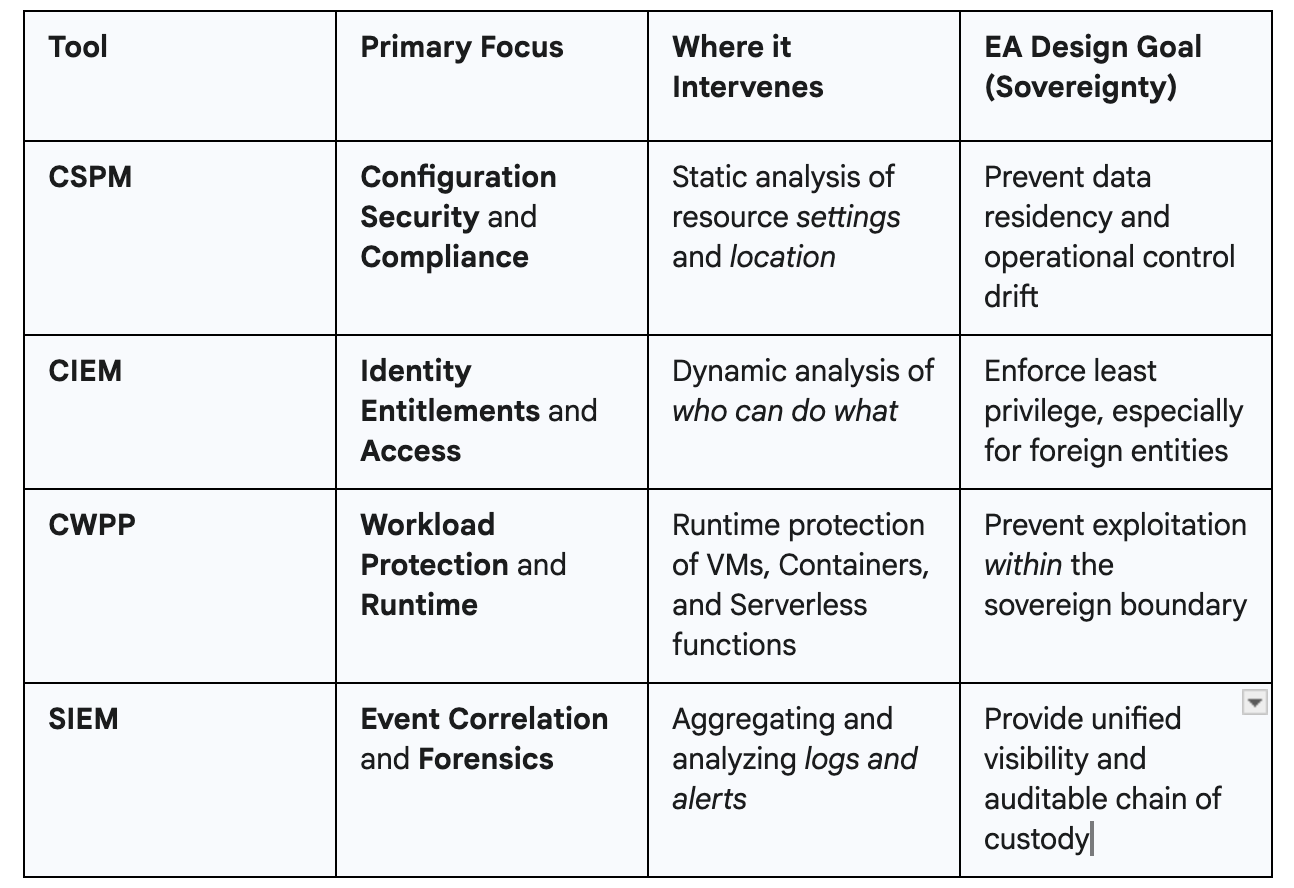
The Architect’s Perspective: CSPM is the Sovereignty Auditor and Residency Enforcer. It dictates where and how resources must be configured based on legal jurisdiction, serving as the critical upstream control that informs SecOps when a compliance boundary is at risk of being breached.
Architecting CSPM for Multi-Sovereign Consistency
A successful CSPM implementation in a multi-cloud environment requires extreme precision to manage differing jurisdictional policies.
The Centralized CSPM Plane: Architect the CSPM tool as a centralized security management plane capable of ingesting configuration data from all cloud accounts, including specific Sovereign Cloud regions and segregated zones. This ensures unified risk scoring and posture reporting across diverse legal environments.
Harmonized Sovereign Policy Sets: Policy standards must prioritize the strictest jurisdictional requirements. Focus on abstract, outcome-based sovereign policies (e.g., “All regulatory data must reside within Region X and be encrypted with CMK Z”) that the CSPM tool can translate and enforce across every provider utilized.
Integrating CMK and Geo-Fencing Checks: The CSPM capability must explicitly check for the mandatory use of Customer Managed Keys (CMKs) in the appropriate local HSMs. Furthermore, it must verify network controls and tagging to confirm strict Geo-Fencing rules are in place and that inter-region peering is appropriately restricted.
Security Telemetry Integration for Compliance: Design the architecture to stream all CSPM findings (misconfiguration alerts, compliance failures related to residency) directly to your centralized SIEM or Security Data Lake. This correlation provides necessary context for immediate compliance incident response and ensures an immutable record for regulators.
Policy-as-Code: Codifying and Testing Sovereign Guardrails
The most strategic defense against sovereignty breaches is prevention through Policy-as-Code (PaC), embedding security guardrails directly into the development and deployment lifecycle.
The Problem with Remediation: Remediation means a sovereignty violation has already occurred (data drift), potentially incurring massive fines or legal exposure.
The PaC Solution: PaC enables security teams to define Sovereign Guardrails as version-controlled code (e.g., using frameworks like Open Policy Agent (OPA) or native cloud policies).
Integrating PaC into CI/CD:
Develop: Security Architects codify rules (e.g., “Resource location tag MUST equal ‘Region X’”).
Test: These sovereign policies are tested against Infrastructure-as-Code (IaC) templates (before deployment) to ensure the requested deployment is compliant.
Prevent: The PaC tool acts as a mandatory gate in the CI/CD pipeline, blocking deployment if the IaC template proposes non-compliant configurations (e.g., using a global storage class).
Enforce: The same sovereign policy set is deployed via CSPM to continuously detect and report drift if manual administrative changes occur in production.
This layered approach ensures security controls are applied consistently at the earliest stage possible, legally and architecturally.
Operationalizing Remediation: Fixing Compliance Breaches
Effective CSPM requires a structured approach to remediating compliance breaches, with clear accountability linked to sovereign data ownership.
Automated Remediation for Low-Risk Drift: Architect workflows within the CSPM/SOAR platform for low-risk sovereignty drift (e.g., enabling audit logs in a local region, applying mandatory resource tags). This accelerates adherence to controls.
Human-Guided Remediation for Compliance Breach: For high-risk violations (e.g., identifying a database configured for global replication), design a process that automatically notifies the data owner, creates an urgent compliance ticket, and provides clear steps to revert the configuration to a compliant state, requiring explicit legal and compliance team approval.
Ownership and Accountability: Integrate CSPM findings with data ownership tags and geographical resource tags. This ensures compliance breach alerts go directly to the designated Data Owner responsible for that sovereign data set, who is legally accountable for the configuration.
The Security-FinOps Bridge: Configure CSPM to identify resources that violate sovereignty and result in unnecessary cost (e.g., retaining redundant backups in a non-compliant foreign region). This aligns sovereignty goals with FinOps goals by eliminating non-compliant, wasteful expenditure.
Conclusion
In the Sovereign Cloud Era, CSPM transcends basic security hygiene; it becomes the indispensable compliance engine that protects your organization from catastrophic legal and regulatory exposure.
For the Enterprise Architect, operationalizing CSPM means moving beyond detection to prevention: building a Policy-as-Code framework that codifies legal requirements into automated guardrails, centralizes governance across all sovereign and global cloud zones, and enforces both security and compliance simultaneously. By mastering this capability, you solidify the legal and security integrity of your entire multi-cloud enterprise.