

Modern Digital Security Operations: Integrating SIEM, XDR, and SOAR with TOGAF
Architecting advanced threat detection, automated response, and continuous intelligence for the resilient enterprise.

Introduction
Having established the critical importance of Identity & Access Management as the new control plane in our last discussion, let’s move towards the dynamic realm of Modern Digital Security Operations. In 2025, the sheer volume and sophistication of cyber threats demand more than just reactive defenses; they necessitate a proactive, intelligent, and highly automated Security Operations Center (SOC).
The traditional SOC model, often overwhelmed by alert fatigue and manual processes, is no longer sufficient. Enterprise Architects are tasked with designing a converged security operations framework that integrates disparate data sources, automates responses, and provides comprehensive visibility across the entire digital estate.
This article will provide a blueprint for architecting a future-ready SOC, focusing on the strategic integration of Security Information and Event Management (SIEM), Extended Detection and Response (XDR), and Security Orchestration, Automation, and Response (SOAR). We will consistently anchor our approach in the TOGAF Standards ensuring that these critical security capabilities are seamlessly woven into the fabric of the enterprise architecture.
1: Business Drivers for Advanced Security Operations (TOGAF Phase B: Business Architecture)
The Business Architecture phase requires EAs to articulate the strategic imperatives driving the need for advanced security operations. In 2025, these are directly tied to organizational resilience and trust:
Accelerated Threat Landscape: The increasing volume, sophistication, and speed of cyberattacks (e.g., AI-driven phishing, polymorphic malware, supply chain attacks) demand faster detection and response capabilities to minimize business impact.
Expanded Attack Surface: The shift to multi-cloud, remote work, and proliferating IoT/OT devices has vastly expanded the attack surface, requiring comprehensive visibility across all assets and interactions.
Regulatory and Compliance Demands: Stringent data protection regulations and industry standards necessitate demonstrable and auditable security operations, including robust logging, incident reporting, and forensic capabilities.
Operational Efficiency and Talent Shortage: Manual security processes lead to alert fatigue and burnout, exacerbating the global cybersecurity talent shortage. Businesses require automated, efficient operations to maximize existing resources.
Brand Reputation and Customer Trust: Security incidents can severely damage brand reputation and erode customer trust. Proactive security operations are essential for maintaining market standing and customer confidence.
The output of TOGAF Phase B will be a clear set of business requirements for an agile, efficient, and highly effective security operations capability that protects critical assets and ensures continuity.
2: Visioning the Future SOC (TOGAF Phase A: Architecture Vision)
The Architecture Vision phase establishes the high-level direction for the security operations transformation, aligning stakeholders and defining foundational principles.
Core Principles of Modern Security Operations: EAs must articulate guiding principles for the future SOC, such as:
Proactive Defense: Shifting from reactive incident response to proactive threat hunting and prediction.
Unified Visibility: Consolidating security telemetry from all sources (endpoint, network, cloud, identity) for a holistic view.
Automation-First Response: Automating repetitive tasks and orchestrating complex workflows to accelerate incident resolution.
Context-Rich Intelligence: Enriching alerts with threat intelligence and contextual data for informed decision-making.
Continuous Improvement: Embracing feedback loops and iterative refinement of security playbooks and detection rules.
Vision Statement for the Future SOC: A compelling vision statement might be: "To establish an intelligent, automated, and continuously adapting security operations center that provides pervasive threat visibility, accelerates incident response, and proactively protects the enterprise against evolving cyber threats across all digital domains."
Stakeholder Alignment and Scope: Engaging CISOs, IT Operations, Legal, and business leaders to define the scope of the SOC modernization, identify critical assets to protect, and agree on key performance indicators (KPIs) for security operations.
The output of TOGAF Phase A is a shared Architecture Vision, a set of guiding principles, a defined scope, and measurable success criteria for the modern security operations framework.
3: Capability Model and Logical Architecture for SecOps (TOGAF Phase C: Information Systems Architecture)
The Information Systems Architecture phase defines the functional capabilities and logical components required for advanced security operations.
Core Security Operations Capabilities:
Security Information and Event Management (SIEM): Centralized collection, normalization, correlation, and long-term storage of security logs and events from across the entire enterprise. This provides a single source of truth for security data.
Extended Detection and Response (XDR): Holistic threat detection and response that unifies telemetry from endpoints, cloud workloads, networks, identity, and email, providing cross-domain visibility and automated context.
Security Orchestration, Automation, and Response (SOAR): Automation of security playbooks, orchestration of security tools, and streamlined incident response workflows, enabling rapid and consistent actions.
Threat Intelligence Platform (TIP): Ingestion, aggregation, and dissemination of internal and external threat intelligence to enrich alerts and inform proactive threat hunting.
User and Entity Behavior Analytics (UEBA): Leveraging AI/ML to detect anomalous user and entity behavior, identifying insider threats and compromised accounts.
Vulnerability Management Integration: Feeding vulnerability data into the SOC for risk prioritization and contextualizing alerts.
Incident Management & Case Management: Structured processes and tools for managing the full lifecycle of security incidents, from detection to resolution and post-mortem analysis.
Threat Hunting: Proactive, hypothesis-driven search for undetected threats within the enterprise environment, leveraging rich telemetry.
Reporting & Compliance: Generating comprehensive reports for compliance audits, security posture assessment, and executive dashboards.
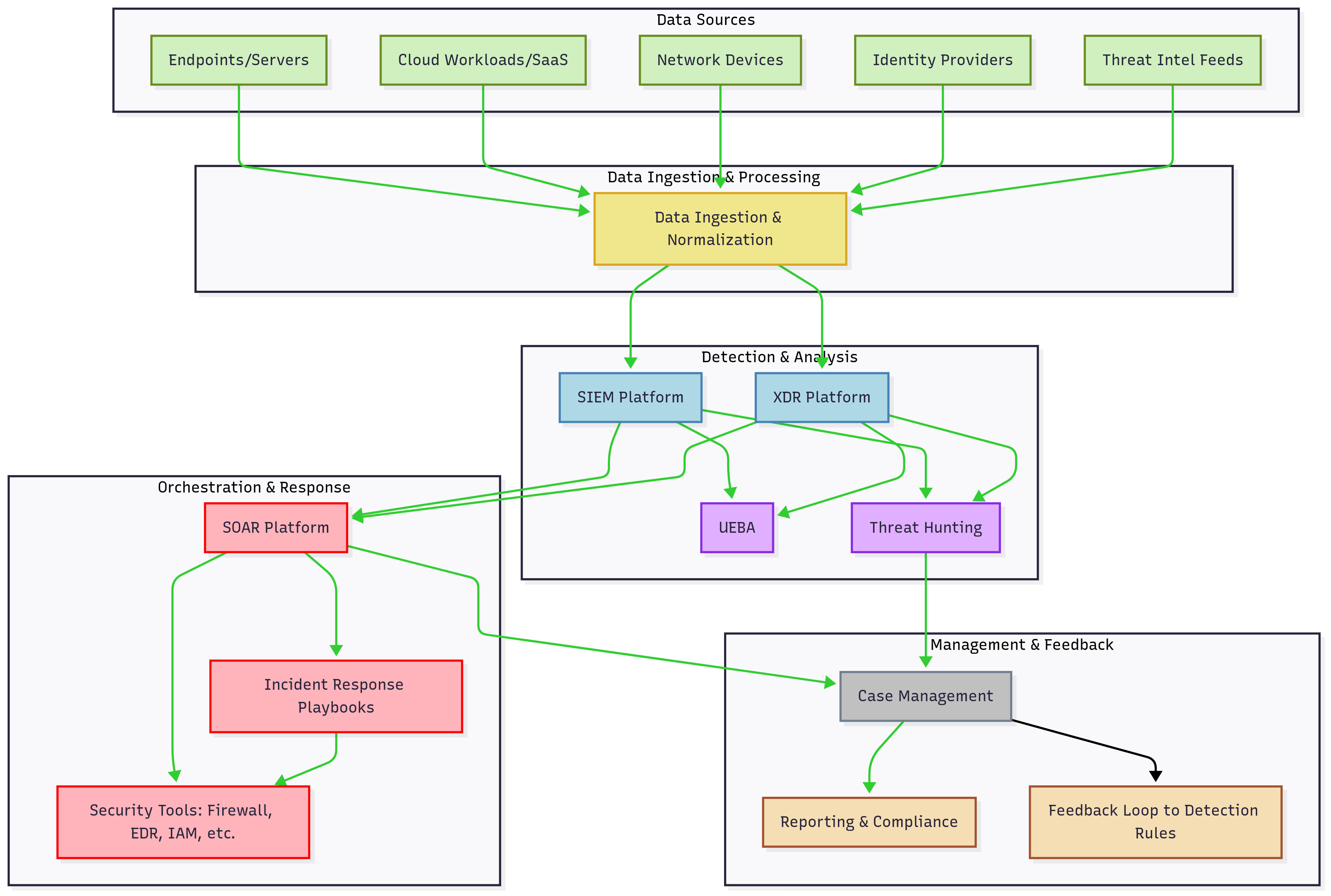
Logical Reference Architecture Diagram: A modern SOC architecture emphasizes data ingestion, correlation, automation, and continuous feedback.
4: Selecting the Stack and Guardrails (TOGAF Phase D: Technology Architecture)
The Technology Architecture phase focuses on selecting and integrating the specific tools and platforms that will enable the defined security operations capabilities.
Unified Security Data Lake/Platform: Architecting a centralized platform for ingesting, storing, and analyzing vast volumes of security telemetry. This often involves cloud-native data lakes or specialized security data platforms that can scale to petabytes.
SIEM/XDR Integration: Selecting platforms that offer strong integration capabilities between SIEM (for log management and compliance) and XDR (for cross-domain threat detection and response). Prioritize solutions that leverage AI/ML for anomaly detection and alert prioritizations.
SOAR Automation Engine: Choosing a SOAR platform that can orchestrate actions across a diverse set of existing security tools (e.g., EDR, firewalls, IAM systems, vulnerability scanners). The platform should support custom playbook development and integration with threat intelligence feeds.
Threat Intelligence Integration: Implementing a robust Threat Intelligence Platform (TIP) that aggregates intelligence from various sources (commercial feeds, open-source, ISACs) and automatically enriches alerts within SIEM/XDR.
Cloud-Native Security Tools: Leveraging native security services within cloud environments (e.g., cloud security posture management, cloud workload protection) and integrating their telemetry into the centralized SOC platform.
Security Orchestration and Automation: Prioritizing tools that enable "security-as-code," allowing for version-controlled and automated deployment of detection rules, playbooks, and response actions.
EA's Role: Defining the interoperability standards, API requirements, and data flow architectures to ensure seamless integration between these diverse security technologies. This aligns with TOGAF's emphasis on defining the logical and physical technology components.
5: Operationalizing the Modern SOC (TOGAF Phase G: Implementation Governance)
The Implementation Governance phase is crucial for overseeing the realization of the modern SOC architecture and establishing a sustainable operating model.
Playbook Development and Automation: Establishing a continuous process for developing, testing, and automating incident response playbooks within the SOAR platform. Prioritize automation for high-volume, low-complexity alerts.
Detection Engineering and Tuning: Implementing a dedicated function for detection engineering, continuously refining SIEM/XDR rules and models to reduce false positives and improve detection accuracy. This involves close collaboration between SecOps and threat intelligence teams.
Threat Hunting Program: Establishing a proactive threat hunting program, leveraging the rich telemetry from SIEM/XDR and threat intelligence to search for advanced persistent threats (APTs) that may have bypassed automated defenses.
Metrics and Reporting: Defining key performance indicators (KPIs) and metrics for SOC effectiveness, such as Mean Time To Detect (MTTD), Mean Time To Respond (MTTR), false positive rate, and coverage of critical assets. Regular reporting to stakeholders on security posture and incident trends.
Continuous Training and Skill Development: Investing in continuous training for SOC analysts to keep pace with evolving threats and new security technologies, fostering a culture of learning and adaptation.
RACI Model for Modern SOC Operations:
Enterprise Architect (EA): Responsible for defining the overall security operations architecture, capability map, and reference architecture. Accountable for the architectural integrity and strategic alignment of the SOC.
SOC Manager/Lead: Responsible for day-to-day operations, incident management, team performance, and continuous improvement. Accountable for overall SOC effectiveness.
Security Analysts (Tier 1/2/3): Responsible for alert triage, investigation, incident response, and threat hunting.
Detection Engineers: Responsible for developing, testing, and tuning detection rules and models.
Security Automation Engineers: Responsible for developing and maintaining SOAR playbooks and integrations.
Threat Intelligence Analysts: Responsible for curating and disseminating threat intelligence.
IT Operations/Cloud Teams: Responsible for ensuring proper logging and telemetry ingestion from their respective domains.
6: Quick Maturity Self-Assessment
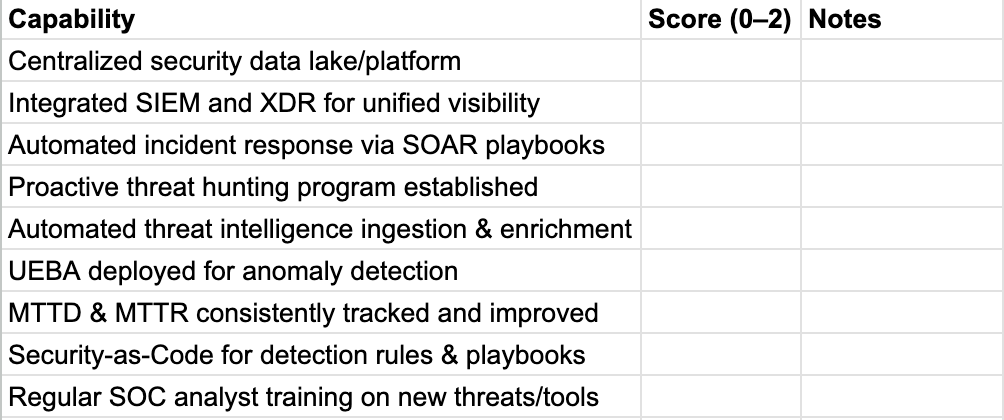
This self-assessment provides a snapshot of organization's Modern Digital Security Operations maturity.
Score each capability from 0 (Not Started) to 2 (Mature/Automated). Sum your scores quarterly to track progress.
7: Two-Quarter Roadmap (Example)
Modernizing security operations is an iterative journey. This example roadmap outlines key initiatives for the first two quarters.
Q1 (0–90 days): Visibility and Foundational Automation
Unified Log Ingestion: Centralize logging from critical endpoints, cloud environments, and identity providers into a security data lake/platform.
SIEM/XDR Baseline Deployment: Implement initial SIEM and XDR platforms, focusing on core detection rules for high-priority threats.
SOAR Pilot for Tier 1 Alerts: Automate incident enrichment and initial response actions for 3-5 high-volume, low-complexity alerts (e.g., phishing email analysis, suspicious login).
Threat Intelligence Feed Integration: Integrate 1-2 primary threat intelligence feeds into SIEM/XDR for automated alert enrichment.
MTTD/MTTR Baseline: Establish baseline metrics for Mean Time To Detect (MTTD) and Mean Time To Respond (MTTR) for critical incident types.
Q2 (90–180 days): Expansion and Proactive Capabilities
Expand XDR Coverage: Extend XDR deployment to cover additional cloud workloads, network segments, and SaaS applications.
UEBA Pilot for Critical Users: Implement UEBA for a pilot group of privileged users and high-risk entities to detect anomalous behavior.
Threat Hunting Playbook Development: Develop and execute 1-2 initial threat hunting playbooks based on recent threat intelligence.
Automate Additional Playbooks: Automate 5-7 more incident response playbooks within SOAR, focusing on common incident types and repetitive tasks.
Security-as-Code Pilot: Implement a pilot for managing SIEM/XDR detection rules and SOAR playbooks as code in a version-controlled repository.
SOC Training Program: Launch a continuous training program for SOC analysts focusing on new threats, XDR capabilities, and SOAR usage.
8: Risks and Anti-Patterns
Enterprise Architects must be aware of common pitfalls that can hinder the modernization of security operations:
Alert Fatigue: Overwhelming SOC analysts with a high volume of low-fidelity alerts, leading to missed critical incidents.
Tool Sprawl without Integration: Deploying numerous security tools that do not effectively integrate, creating data silos and operational inefficiencies.
"Set and Forget" Automation: Automating responses without continuous monitoring, testing, and refinement of playbooks, leading to ineffective or even detrimental actions.
Lack of Context: Security alerts lacking sufficient context (e.g., user identity, device posture, business criticality) making rapid investigation and response difficult.
Ignoring Threat Intelligence: Failing to effectively integrate and operationalize threat intelligence to inform detection and hunting efforts.
Over-reliance on Signatures: Relying solely on signature-based detection, which is ineffective against novel or polymorphic threats.
Insufficient Data Governance: Lack of clear policies for data retention, access, and privacy for security telemetry.
Conclusion
Modern Digital Security Operations, powered by the intelligent integration of SIEM, XDR, and SOAR, are indispensable for safeguarding the enterprise in 2025. The Enterprise Architect plays a pivotal role in designing this converged SOC, translating business imperatives into a cohesive architectural vision, defining robust capabilities, and guiding the implementation of advanced security technologies.
By embracing a proactive, automated, and intelligence-driven approach, EAs enable organizations to detect threats faster, respond more effectively, and build inherent resilience against the ever-evolving cyber landscape.
Share your biggest challenge in modernizing your SOC in the comments!